Forget the sci-fi fantasy of robots running everything. The real story isn’t about flashy tech, it’s about a smarter way to work. Hyperautomation is that smarter way: A deliberate, all-hands-on-deck strategy where organizations systematically find, prioritize and overhaul their processes. It’s the art of weaving together the right digital tools, not just to replace a single task, but to reinvent entire workflows from start to finish.
Clicking this to DevOps and SRE teams, automation is a daily reality. However, hyperautomation represents a significant step beyond standard scripts and scheduled tasks. It’s not a single software package you can buy; rather, it’s a business-driven, disciplined approach used to rapidly identify and automate as many IT and business processes as possible.
Hyperautomation involves the strategic orchestration of multiple technologies — such as AI, machine learning (ML), robotic process automation (RPA) and event-driven architecture — to create an integrated framework for end-to-end process optimization.
Think of it as conducting a symphony, not just playing one instrument. This integrated approach brings powerful technologies together:
In the hyperautomation “stack,” Ansible serves as a primary execution engine for infrastructure and configuration. If AI and workflow engines represent the “brains” making decisions, Ansible represents the “hands” that perform the actual work in the real world.
While tools like ServiceNow handle IT Service Management (ITSM) and orchestration, Ansible provides the Infrastructure-as-Code (IaC) capabilities necessary to modify cloud environments, deploy clusters or patch thousands of servers across hybrid landscapes.
The shift from traditional methods to hyperautomation is a fundamental paradigm shift in how complexity is managed:
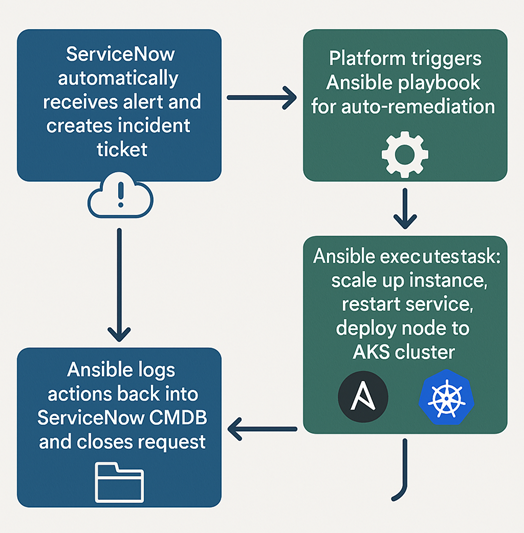
A practical example of this synergy is the integration between an ITSM platform (like ServiceNow) and Ansible to handle cloud infrastructure failures.
Imagine a scenario where AWS CloudWatch detects a spiking CPU on a mission-critical EC2 instance. In a traditional setup, this might trigger an email to an SRE who manually investigates. In a hyperautomated workflow:
Raul Leite
Implementing Ansible within a hyperautomation framework delivers measurable operational gains:
A common pitfall for engineering teams is assuming that “Ansible alone equals hyperautomation.” Because hyperautomation is a modular strategy, no single tool can manage the entire lifecycle.
Ansible is exceptional at execution, but a complete strategy requires integration with:
Lastly, Ansible is a critical enabler of hyperautomation because it provides the reliable, audit-friendly execution layer needed to transform strategy into tangible action. However, it is only one instrument in the orchestra. To achieve true hyperautomation, you must surround Ansible’s execution power with the “intelligence” of AI/ML and the “orchestration” of high-level workflow platforms to create a harmonious business symphony.
If hyperautomation is like a self-driving car, the AI is the navigation system and sensors, the workflow engine is the central computer coordinating everything, and Ansible is the engine and transmission that actually moves the vehicle forward.
This article is published as part of the Foundry Expert Contributor Network.
Want to join?